Archive For: Events

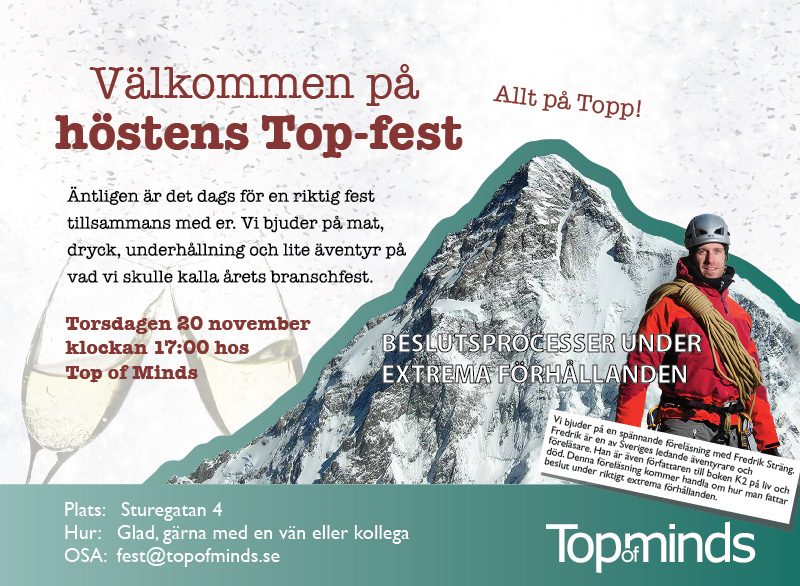
Tack för att ni gjorde vår fest till en succé 2014

Vi lovade årets branschfest. Med över 250 gäster som kom och en fest som pågick långt in på sena natten tror jag vi kan säga att vi höll vad vi lovade. Föreläsningen med Fredrik Sträng var mycket uppskattad och klätterbanan med det avslutande toppfoto var succé.

Stort grattis till det vinnande laget!!!

Vinnarna!!!

Magnus H
Caroline
Emma
Jenny
Markus
Johannes
Fredrik

Antal rätt Quiz: 6

Tid Klätterbanan: 2:35

Total poäng: 8

Vi tar med er till Mount Everest i Stockholm

Maila oss för att få mer information om ert deltagande i Skistar Everst Challenge där ni utmanar Top of Minds och andra företag. För er som inte vann så kan ni ändå delta, gå till everestchallenge.se.

Alla Top-bilderna från fotobåset

Lite statistik

257 Gäster
152 Lyssnade på föreläsningen
111 Tävlande
200 Korvar åts
168 Flaskor bubbel
146 Bilder togs i fotobåset
7 krossade glas

Bruno och Inga från Östermalms korvspecilist bjöd på sina makalöst goda korvar.

I Mindball fick alla försöka fokusera under press.

Inbjudan…


2014-11-17 Kurs Certifierad Data vault modellerare (CDVDM) i Malmö


Lär dig Data vault modellering av Hans Hultgren.

Registrera dig för en tvådagarskurs och bli Certified Data Vault Data Modeler (CDVDM).
Genom lärarledda lektioner, omfattande labb-övningar och förberedande videolektioner online kan du bli certifierad i vad Bill Inmon kallar “optimal choice for modeling the EDW in the DW 2.0 framework“.


OBS! Denna kurs hålls i Malmö. Adress: Affectos lokaler på Baltzarsgatan 21b, Malmö

Läs mer om kursinnehållet här.


2014-12-08 Kurs: Ensemble modeling

Ensemble Modeling Day

Overview
Data modeling for a data warehouse is different than data modeling for an operational system or for a data mart. The data warehouse has a unique set of objectives, requirements, capabilities and constraints. Amongst these are the need to track history and the need to integrate data from several different sources. Today the demands of the data warehouse have been greatly expanded. It is now common that the data warehouse have auditable and trusted data, that the warehouse be capable of adapting very quickly to changes (new sources, changing sources, changing business rules, new deliveries, etc.), that the warehouse have very low latency towards near-real time performance, and the list goes on.
In response to this growing set of unique characteristics several innovative modeling  techniques have emerged. Leading this set of new approaches is the Data Vault modeling approach. But there are several others as well including Anchor, 2G, 6NF, Temporal, Hyper Agility, Focal, and others. While the specific approaches vary, they are all forms of data warehouse modeling; they are all forms of Ensemble Modeling.

Ensemble Modeling = Data Warehouse Modeling

To understand Ensemble Modeling is to understand how new and innovative forms of modeling for the data warehouse environment differ from traditional forms, and also from each other. Moving forward you will be applying Ensemble Modeling for your EDW. This course is focused on explaining what this means and why you will be doing it. Also in this course you will gain insight into how to formalize your specific modeling pattern to match the specific needs of your organization and your EDW program. This course includes resources and materials intended to support the learning process before and after the training day itself.

Course Description
This is a complete Ensemble Modeling course. It covers all aspects of Ensemble Modeling including Unified Decomposition, Core Business Concepts, understanding Ensembles, designing Ensembles, Concept Constellations, Attribute Clusters, modeling variations, and
Ensemble feature mapping for assessing the pros and cons of specific Ensemble modeling patterns.
Students will gain a new perspective on modeling the data warehouse and a deeper understanding of the paradigm shift that is required to make these techniques succeed. This course will guide students towards a sense of clarity concerning the design and
modeling of a successful data warehouse. This course will describe and categorize several of the Ensemble modeling pattern
variations. The course consists of three (3) components: The one day classroom course, the online video lessons, and the course materials.

Classroom course day

  • Lectures
  • Case Lab
  • Exercises

The classroom day is scheduled in a location that includes table space for each student to work, break-out areas for small group learning exercises, white boards, flip charts, and a presentation projector used during the lectures. The classroom day is engaging and highly interactive with the students. The day includes lectures, case labs, and workbook exercises. The classroom course runs 09:00 to 17:00. Students arrive for coffee and introductions beginning at 08:30. Class starts promptly at 09:00.

Course Materials
This course includes detailed course materials to help support the learning process. Beyond the classroom, several of the items are intended to be used as references and guides to support your ongoing modeling efforts.

Target Audience
This course is intended business intelligence and data warehousing professionals. The class is intended for persons who are involved with the business, understanding the business models, gathering requirements, designing solutions, information modeling, data modeling and mart design.
The class is perfect for all forms of modelers and architects including Information Modelers, Data Modelers, Data Architects, Information Architects, and Business Analysts. Also for Business Intelligence and Data Warehousing managers, Master Data Management (MDM) professionals, designers, project leads and project owners, DW DBAs, Data Mart designers, Integration Experts, ETL Developers, and Functional Area Representatives. Ensemble modeling is closely aligned with the business so those who are working from both business and technical perspectives will benefit equally from this course.

Logistics and Fees
All students should be enrolled at least one (1) week before the classroom course day.

Please plan for this lead time in your schedule when you register for the course. Plan to arrive to the training location by 08:30 for the classroom course day. For planning purposes the end of class is 17:00 however it is typical that students have questions after the end of class. The instructor is available until 18:00 to discuss questions.

Location: Sturegatan 4 in central Stockholm.

Cost: 8 950 SEK

The course is held by Hans Hultgren.

 

2014-09-01 Informatica Big Data Training in Stockholm

Welcome to Informatica Big Data training session in Stockholm 1st – 3rd of September.

It will be a great event with a lot of learning, networking and fun.

Big Data is bigger than ever and Informatica is uniquely positioned to help our customers and prospects in this transition.

Agenda:

1st September, Monday evening 18:00 – 20:00

Location: Spotify office

  • BIG DATA presentation at Stockholm Hadoop user group SHUG

2nd September, Tuesday whole day 09:00-17:00

Location: Top of Minds

  • Big Data Defined/ ecosystem update
  • Big Data Processing – Hadoop
  • Informatica & Hadoop
  • Hadoop Vendors
  • Use Cases and success stories
  • IT Vendors
  • NoSQL
  • Licensing
  • Informatica Challenges
  • Big Data Logistics

3rd September Wednesday whole day 09:00-17:00

Location: Top of Minds

  • Hands-on Informatica Big Data Trial Edition
  • Technical practice based in Informatica BDE


2014-05-08 Kurs Certifierad Data vault modellerare (CDVDM) i Malmö


Lär dig Data vault modellering av Hans Hultgren.

Registrera dig för en tvådagarskurs och bli Certified Data Vault Data Modeler (CDVDM).
Genom lärarledda lektioner, omfattande labb-övningar och förberedande videolektioner online kan du bli certifierad i vad Bill Inmon kallar “optimal choice for modeling the EDW in the DW 2.0 framework“.


OBS! Denna kurs hålls i Malmö. Adress: Affectos lokaler på Baltzarsgatan 21b, Malmö

Läs mer om kursinnehållet här.


Strålande Afterwork med föreläsning

Tack alla som kom på vår after work och föreläsning den 28e mars. Det var en hellyckad kväll med ca 35 lyssnare och 60-tal på Afterworken. Hans Hultgrens föreläsning om hur man effektivare kan bygga sina datalager var väldigt uppskattat bland besökarna. Kommentarer bland gästerna var ”Verkligen en ögonöppnare att man kan skala det från det lilla till stort och samtidigt göra det långsiktigt hållbart.”, ”Superintressant!”

Fler events kommer inom kort, ses snart hoppas vi.

Allt på topp!


2014-06-02 Kurs: Ensemble modeling

Ensemble Modeling Day

Overview
Data modeling for a data warehouse is different than data modeling for an operational system or for a data mart. The data warehouse has a unique set of objectives, requirements, capabilities and constraints. Amongst these are the need to track history and the need to integrate data from several different sources. Today the demands of the data warehouse have been greatly expanded. It is now common that the data warehouse have auditable and trusted data, that the warehouse be capable of adapting very quickly to changes (new sources, changing sources, changing business rules, new deliveries, etc.), that the warehouse have very low latency towards near-real time performance, and the list goes on.
In response to this growing set of unique characteristics several innovative modeling  techniques have emerged. Leading this set of new approaches is the Data Vault modeling approach. But there are several others as well including Anchor, 2G, 6NF, Temporal, Hyper Agility, Focal, and others. While the specific approaches vary, they are all forms of data warehouse modeling; they are all forms of Ensemble Modeling.

Ensemble Modeling = Data Warehouse Modeling

To understand Ensemble Modeling is to understand how new and innovative forms of modeling for the data warehouse environment differ from traditional forms, and also from each other. Moving forward you will be applying Ensemble Modeling for your EDW. This course is focused on explaining what this means and why you will be doing it. Also in this course you will gain insight into how to formalize your specific modeling pattern to match the specific needs of your organization and your EDW program. This course includes resources and materials intended to support the learning process before and after the training day itself.

Course Description
This is a complete Ensemble Modeling course. It covers all aspects of Ensemble Modeling including Unified Decomposition, Core Business Concepts, understanding Ensembles, designing Ensembles, Concept Constellations, Attribute Clusters, modeling variations, and
Ensemble feature mapping for assessing the pros and cons of specific Ensemble modeling patterns.
Students will gain a new perspective on modeling the data warehouse and a deeper understanding of the paradigm shift that is required to make these techniques succeed. This course will guide students towards a sense of clarity concerning the design and
modeling of a successful data warehouse. This course will describe and categorize several of the Ensemble modeling pattern
variations. The course consists of three (3) components: The one day classroom course, the online video lessons, and the course materials.

Classroom course day

  • Lectures
  • Case Lab
  • Exercises

The classroom day is scheduled in a location that includes table space for each student to work, break-out areas for small group learning exercises, white boards, flip charts, and a presentation projector used during the lectures. The classroom day is engaging and highly interactive with the students. The day includes lectures, case labs, and workbook exercises. The classroom course runs 09:00 to 17:00. Students arrive for coffee and introductions beginning at 08:30. Class starts promptly at 09:00.

Course Materials
This course includes detailed course materials to help support the learning process. Beyond the classroom, several of the items are intended to be used as references and guides to support your ongoing modeling efforts.

Target Audience
This course is intended business intelligence and data warehousing professionals. The class is intended for persons who are involved with the business, understanding the business models, gathering requirements, designing solutions, information modeling, data modeling and mart design.
The class is perfect for all forms of modelers and architects including Information Modelers, Data Modelers, Data Architects, Information Architects, and Business Analysts. Also for Business Intelligence and Data Warehousing managers, Master Data Management (MDM) professionals, designers, project leads and project owners, DW DBAs, Data Mart designers, Integration Experts, ETL Developers, and Functional Area Representatives. Ensemble modeling is closely aligned with the business so those who are working from both business and technical perspectives will benefit equally from this course.

Logistics and Fees
All students should be enrolled at least one (1) week before the classroom course day.

Please plan for this lead time in your schedule when you register for the course. Plan to arrive to the training location by 08:30 for the classroom course day. For planning purposes the end of class is 17:00 however it is typical that students have questions after the end of class. The instructor is available until 18:00 to discuss questions.

Location: Sturegatan 4 in central Stockholm.

Cost: 8 950 SEK

The course is held by Hans Hultgren.